
Alltagsküche
Kochen, wie es zuhause schmeckt
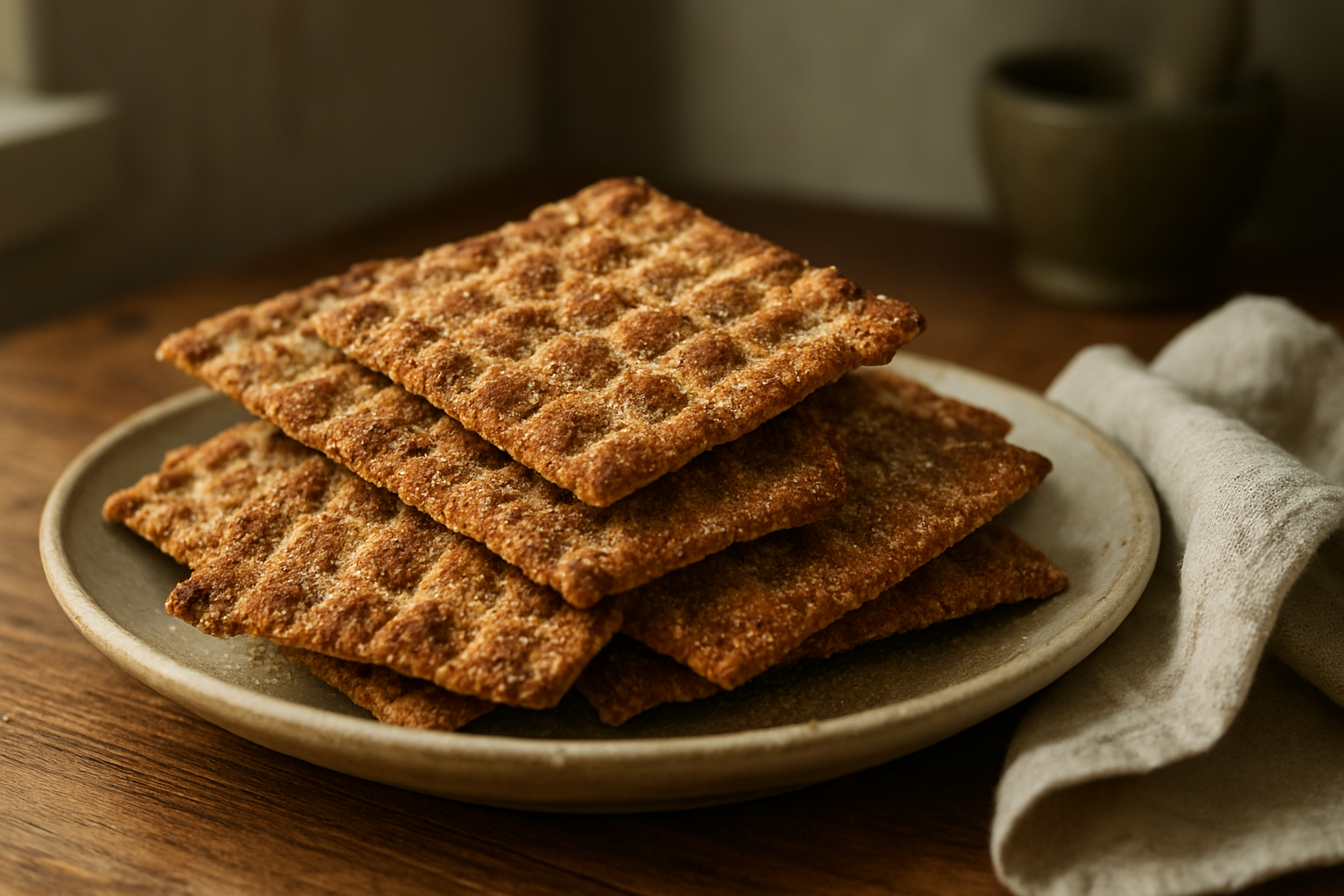
Homemade German-Style Crispbread
🛒 Ingredients
- ✓
450 g strong white bread flour
- ✓
1 level teaspoon baking powder, approximately 4 g
- ✓
7 g dried yeast
- ✓
2 level teaspoons fine salt, approximately 10 g
- ✓
150 ml whole milk
- ✓
150 ml buttermilk
- ✓
40 g unsalted butter
- ✓
A little flour for the work surface
- ✓
2 to 3 tablespoons water for brushing
- ✓
25 g wheat bran for topping
📊 Nutritional Information
This recipe is also available in German.
📌 Overview
This homemade crispbread is prepared with wheat flour, milk, buttermilk and a small amount of butter. Yeast and baking powder lightly aerate the dough before it is divided into 24 thin rounds and deeply docked. Wheat bran adds a rustic flavour and extra texture to the surface. Even thickness, a dry underside and complete cooling on a wire rack are essential for a properly crisp result.
You may also find it useful to look at recipes Homemade Walnut Bread Recipe with Rye and Wheat Flour, Crisp White Bread Baton, and Buttermilk Loaf with Honey, in addition to this one.
👨🍳 How to make Homemade German-Style Crispbread
- 1
Place the milk, buttermilk and butter in a small saucepan. Warm gently until the butter has melted. The mixture should be lukewarm at approximately 35 to 38°C and must not become hot.
- 2
Combine the flour, baking powder, dried yeast and salt thoroughly in a large mixing bowl.
- 3
Add the lukewarm milk mixture and mix with a dough hook at low speed until combined.
- 4
Knead for approximately 5 minutes at medium to high speed, until the dough is smooth, elastic and only slightly sticky.
- 5
Shape the dough into a ball, dust it lightly with flour and cover the bowl.
- 6
Leave it in a warm, draught-free place for approximately 20 minutes, until it has increased visibly in volume.
- 7
Line three baking trays with baking paper.
- 8
Turn the dough onto a lightly floured work surface and knead it briefly by hand.
- 9
Shape the dough into a long, evenly thick roll and divide it into 24 equal pieces weighing approximately 35 to 40 g each.
- 10
Shape each portion into a ball, then roll it into a thin round approximately 12 to 14 cm across and no more than 2 to 3 mm thick.
- 11
Arrange the rounds over the three prepared trays, leaving a little space between them. Place approximately eight on each tray.
- 12
Dust the rounds lightly with flour, cover them with clean tea towels and leave them to prove for another 20 minutes.
- 13
Use a fork, a spiked dough roller or the textured side of a clean meat mallet to press a deep, even pattern into each round. Pierce almost to the baking paper without completely tearing the dough.
- 14
Preheat the oven to 220°C conventional or 200°C fan.
- 15
Immediately before baking, brush the rounds lightly with water and sprinkle them evenly with wheat bran.
- 16
Bake the trays one at a time on the middle shelf for 11 to 12 minutes each, until the edges begin to brown.
- 17
Before removing each tray, check that the undersides feel dry and firm. Bake softer pieces for another 2 to 3 minutes.
- 18
Transfer the baked crispbreads immediately to a wire rack and allow them to cool completely. Their final crunchy texture develops as they cool.
🧠 Why It Works
Strong wheat flour develops enough gluten for the dough to be rolled very thinly without tearing easily. Yeast creates a lightly porous structure, while baking powder supports aeration during the short proving periods. Deep docking prevents large bubbles and allows moisture to escape evenly. High oven heat dries the thin rounds quickly, and cooling on a rack prevents condensation underneath.
🛠️ Troubleshooting
Why is my crispbread not crunchy?
The rounds may have been rolled too thickly or not dried fully. Keep them no more than 2 to 3 mm thick and make sure the undersides feel dry. Soft pieces can be dried for another 5 to 10 minutes at 120 to 140°C.
Why do large bubbles form in the crispbread?
The dough was not docked deeply enough. Pierce the entire surface evenly with a fork or spiked roller before baking.
Why does the dough shrink while rolling?
The gluten is still too tight. Cover the divided portions and let them rest for 5 minutes before rolling them again.
Why do the edges burn while the centre remains soft?
The centre is probably thicker than the edge. Roll from the middle outwards and avoid making the outer rim excessively thin.
Why does the dough not rise visibly?
The milk mixture may have been too hot, the yeast may be inactive or the room may be too cool. Use lukewarm liquid and extend the proving time by 10 to 15 minutes if necessary.
💡 Tips and Variations
- •
For a more rustic version, replace up to 100 g of the wheat flour with wholemeal rye flour.
- •
Add sesame seeds, linseeds, poppy seeds or sunflower seeds alongside the wheat bran.
- •
For herb crispbread, mix 1 teaspoon dried rosemary, thyme or oregano into the flour.
- •
A small pinch of caraway or fennel seeds gives the crispbread a stronger bread flavour.
- •
Roll the pieces to a similar size and thickness so every batch finishes baking at the same time.
- •
For rectangular crispbread, roll the dough into large sheets, cut them into portions before baking and dock the entire surface.
📦 Storage
- •
Allow the crispbread to cool completely before packing it. Residual heat creates condensation and softens the bread.
- •
Store it in an airtight tin or container at room temperature for approximately 7 to 10 days.
- •
Keep the container dry and away from heat. Refrigeration is unsuitable because of the higher humidity.
- •
Refresh softened crispbread for 5 to 8 minutes in a 130°C oven, then allow it to cool completely again.
- •
Do not store it with soft bread, as it will absorb moisture.
- •
For longer storage, freeze the completely cooled rounds for up to 2 months and crisp them briefly in the oven after thawing.
🍷 Pairing
- •
Serve crispbread with cream cheese, quark, butter or mild sliced cheese.
- •
Savoury spreads such as hummus, herb quark or lentil pâté complement its crunchy texture.
- •
For breakfast, top it with honey, jam or nut butter.
- •
Serve it alongside soups, salads and cold platters.
- •
Small pieces can replace crackers with dips or cheese.
❓ F.A.Q.
How thin should crispbread dough be rolled?
The rounds should be approximately 2 to 3 mm thick. Thinner patches may burn, while significantly thicker areas can remain soft.
Why is crispbread docked before baking?
The holes prevent large air pockets and allow moisture to escape evenly from the dough.
Can I make crispbread without buttermilk?
Yes. Replace the buttermilk with milk or a mixture of milk and plain yogurt. The flavour will be slightly milder.
How can I tell when crispbread is fully baked?
The edges should be lightly browned and the underside should feel dry and firm. Once completely cool, the bread should snap cleanly.
Can the dough be prepared the day before?
Yes. Refrigerate the covered kneaded dough overnight. Allow it to stand at room temperature for about 30 minutes before dividing and shaping.
🏛️ History and Tradition
Crispbread originated primarily in Scandinavia, where thin, dry bread was valued for its long shelf life. Known in German as Knäckebrot, it has also become a familiar breakfast bread and lighter alternative to fresh loaves throughout Germany. In addition to traditional rye versions, milder wheat-based recipes containing milk products and bran are common.
- •
For properly crunchy crispbread, roll the portions evenly and thinly, dock them deeply and bake until completely dry.
- •
Cooling on a wire rack and storing in a dry airtight container preserve the crisp texture.
Rate this recipe
Click or tap the stars to rate