
Alltagsküche
Kochen, wie es zuhause schmeckt
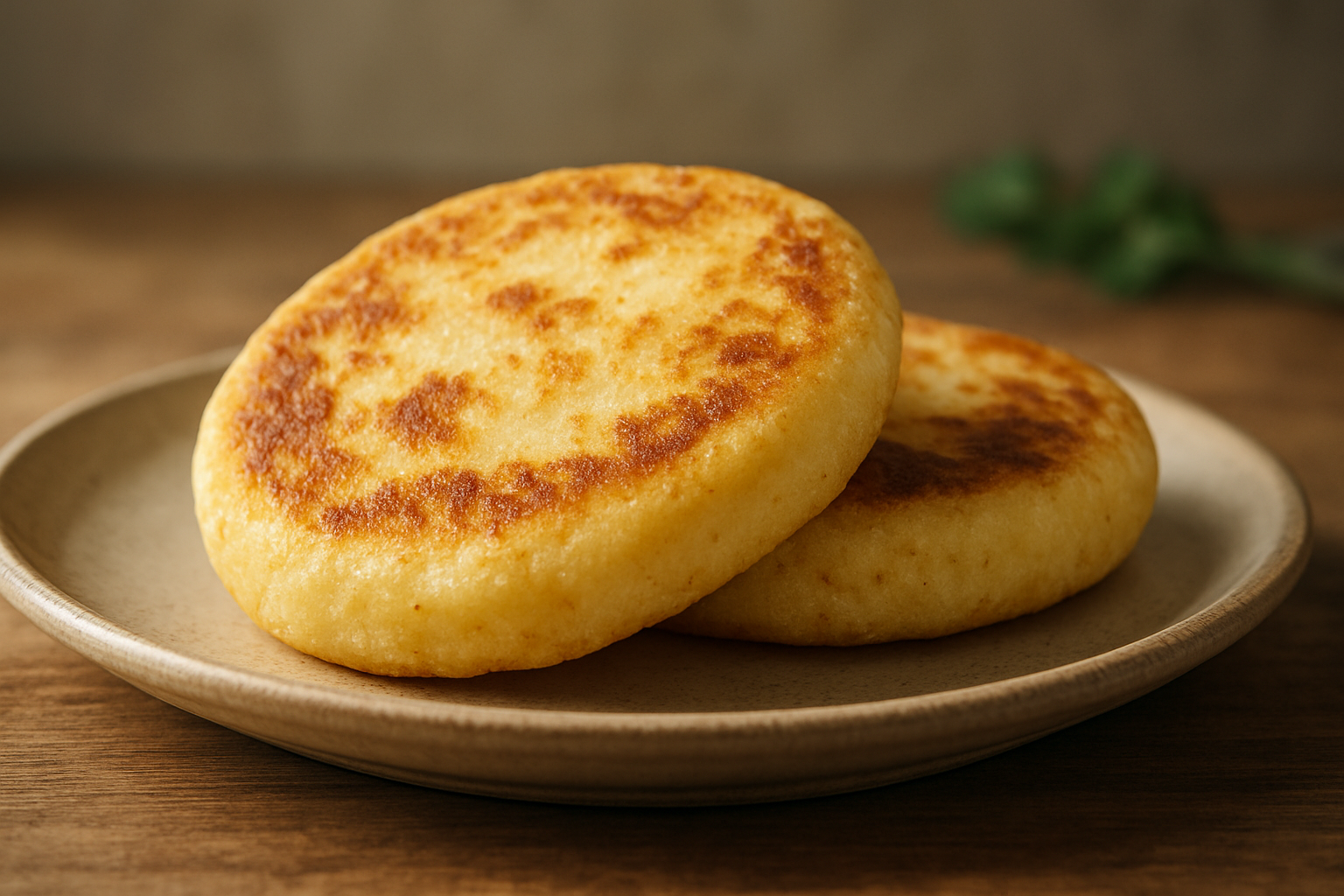
Arepas recipe: easy Venezuelan corn flatbreads
🛒 Ingredients
- ✓
150 g pre-cooked white maize flour for arepas, such as Harina P.A.N. or masarepa
- ✓
1/2 tsp salt
- ✓
200 ml lukewarm water
- ✓
1 tbsp neutral oil, such as sunflower oil, for frying
- ✓
Optional: a little extra water for adjusting the dough
This recipe is also available in German.
📌 Overview
Arepas are Venezuelan and Colombian corn flatbreads made with pre-cooked maize flour, cooked until they form a golden crust while staying soft, moist and slightly grainy inside. This arepas recipe shows the basic method using Harina P.A.N. or another pre-cooked maize flour made for arepas. Regular cornmeal, cornflour or polenta will not give the same result, because they absorb water differently and do not create the authentic arepa texture. With just water, salt and a little oil, you get naturally vegan and gluten-free flatbreads that can be served as a side or split and filled.
The most important detail is the dough texture. It should be soft and easy to shape, but not sticky or crumbly. After a short resting time, the maize flour hydrates more evenly, the edges crack less and the arepas cook more reliably. This recipe also explains why arepas become dry, why they may stay raw inside, how to prevent cracked edges and how to reheat leftovers so the crust comes back.
You may also find it useful to look at recipes Arepas with Neck Steak, Homemade Tortillas, and Ham Döner with Yoghurt Sauce, in addition to this one.
👨🍳 How to make Arepas
- 1
Mix the pre-cooked maize flour and salt in a large bowl. Make sure you are using masarepa or Harina P.A.N., not regular cornmeal, cornflour or polenta.
- 2
Gradually pour in the lukewarm water, stirring with your hands or a spoon until a soft, slightly moist dough forms.
- 3
Let the dough rest for about 10 to 15 minutes so the maize flour can fully hydrate. After resting, the dough usually feels firmer and easier to shape.
- 4
Knead the dough briefly with your hands. It should be smooth, soft and not crumbly. If it cracks or feels dry, add extra water one teaspoon at a time.
- 5
Divide the dough into 3 equal portions. Shape each into a ball, then flatten into a disc about 1.5 cm thick.
- 6
Smooth the edges with lightly damp fingers. Small cracks around the edge mean the dough needs a little more water.
- 7
Heat a non-stick or well-seasoned cast-iron pan over medium heat and brush it lightly with oil. The pan should be hot but not smoking.
- 8
Cook the arepas for about 5 to 7 minutes per side, until golden brown with a firm crust. Turn them carefully with a spatula.
- 9
If the arepas brown too quickly on the outside, reduce the heat. They need time for the inside to cook through and become soft.
- 10
Let the arepas rest for 2 to 3 minutes after cooking. Serve warm as a side, or split them open and fill them.
🧠 Why It Works
Arepas work reliably only with pre-cooked maize flour because this flour has already been heat-treated and absorbs water quickly. That creates a dough that holds together without gluten and forms a firm crust with a soft interior during cooking. Resting the dough matters because it allows the maize flour to hydrate evenly and prevents crumbly edges. Medium heat is essential: it gives the arepas enough time to cook through instead of browning outside while staying raw or overly wet inside. A small amount of oil helps the crust colour without masking the mild corn flavour.
🛠️ Troubleshooting
Why is my arepa dough crumbly?
The dough probably needs more water or more resting time. Let it rest for 10 to 15 minutes, then knead in lukewarm water one teaspoon at a time until it feels soft and easy to shape.
Why is my arepa dough sticky?
The dough may be slightly too wet or may not have rested long enough. Let it stand for a few more minutes. If it still sticks a lot, add a small amount of pre-cooked maize flour.
Why do my arepas crack around the edges?
Cracked edges usually mean the dough is too dry. Smooth the edges with damp fingers, or knead a little more water into the dough and shape the arepas again.
Why are my arepas raw or doughy inside?
The heat was probably too high or the discs were too thick. Cook arepas slowly over medium heat so the crust forms while the centre cooks through. If needed, shape them slightly thinner.
Can I make arepas without Harina P.A.N.?
For authentic arepas, you need pre-cooked maize flour for arepas, also called masarepa. Regular cornmeal, cornflour or polenta have a different texture and do not work reliably as a direct substitute.
Can I prepare arepas ahead of time?
Yes. You can shape the arepas, cover them and keep them in the fridge for a few hours before cooking. Cooked arepas can also be stored, but they are best fresh from the pan.
💡 Tips and Variations
- •
For classic Venezuelan-style filled arepas, split the warm flatbreads and fill them with avocado, beans, cheese, chicken, beef or fried vegetables.
- •
For softer arepas, focus on proper hydration. The dough should feel like soft modelling clay and should not crack as you shape it.
- •
A cast-iron pan gives a stronger crust, while a non-stick pan is easier to manage and needs less oil.
- •
For slightly more flavour, you can add a very small amount of oil directly to the dough. For the basic version, maize flour, water and salt are enough.
- •
Polenta is not an ideal substitute for masarepa. If you experiment with it, the result will be coarser, grainier and less elastic than real arepas.
- •
For filled arepas, do not make the discs too thin. About 1.5 cm gives enough soft centre so they can be split open.
- •
Arepas are naturally vegan and gluten-free as long as you use pure pre-cooked maize flour with no wheat ingredients and choose suitable fillings.
- •
For a firmer crust, you can finish the arepas in a 180°C oven after pan-cooking. This is especially useful for slightly thicker arepas.
📦 Storage
- •
Freshly cooked arepas are best. Let leftovers cool completely, then store them airtight in the fridge for up to 2 days.
- •
To reheat, warm the arepas in a dry frying pan or in a 180°C oven until the crust firms up again. The microwave is less suitable because it can make arepas soft and slightly chewy.
- •
Shaped uncooked arepas can be kept covered in the fridge for a few hours. If the surface dries out, smooth it with lightly damp hands before cooking.
🍷 Pairing
Arepas have a mild corn flavour, so the best pairing depends on the filling. Plain arepas work well with a fresh Riesling or Silvaner because acidity and minerality lift the corn notes. Filled arepas with cheese, beans or meat pair well with a light beer, pale lager or fresh white wine. For a non-alcoholic option, choose lime water, homemade lemonade, lightly sweetened iced tea or sparkling mineral water. The richer the filling, the fresher the drink should be.
❓ F.A.Q.
What flour do I need for arepas?
You need pre-cooked maize flour made for arepas, often sold as Harina P.A.N. or masarepa. Regular cornmeal, polenta or cornflour will not give the same elastic, shapeable dough.
Are arepas gluten-free and vegan?
Yes, the basic dough made from pre-cooked maize flour, water, salt and a little oil is naturally gluten-free and vegan. Check that the maize flour has no wheat-based additives.
What should arepa dough feel like?
It should feel soft, smooth and easy to shape, similar to soft modelling clay. It should not crack from dryness, but it also should not stick heavily to your hands.
Can I fill arepas?
Yes, arepas are often split open and filled. Popular fillings include avocado, cheese, beans, fried vegetables, pulled pork, chicken or beef.
Why are my arepas not crispy?
The pan may be too cool or the arepas may have been turned too soon. Cook them over medium heat long enough for a golden crust to form. A light brushing of oil helps browning.
Can I finish arepas in the oven?
Yes, especially if they are thick. After browning them in the pan, place them in a 180°C oven for a few minutes so the centre cooks through more evenly.
What is the best way to reheat arepas?
A dry pan or the oven is best because it brings back some of the crust. The microwave warms them but usually makes them softer and chewier.
🏛️ History and Tradition
Arepas have been a fundamental part of Venezuelan and Colombian cuisine for centuries, originating from indigenous maize cultivation practices. Traditionally consumed daily, they embody the cultural identity and agricultural heritage of northern South America. Their simplicity and versatility made them a staple across social classes and festive occasions alike. Today, arepas continue to represent authentic Latin American culinary tradition, celebrated internationally for their unique texture and adaptability, reinforcing their status as a cultural and gastronomic icon.
This arepas recipe shows why the right flour and dough texture matter so much. With pre-cooked maize flour, lukewarm water, a short resting time and medium heat, you get corn flatbreads that are crisp outside and soft inside. Arepas are vegan, gluten-free, easy to fill and useful as a side dish, snack or full meal. Once you understand the dough and heat control, they are very reliable to make at home.
Rate this recipe
Click or tap the stars to rate